Root  ·  Nourish  ·  Rise

The body keeps
the score.
So does the classroom.

Nervous system literacy for Black women, children, and the educators who serve them. Because regulated people build regulated communities.

The Problem

Your child isn't the problem.
Neither is their teacher.

When a student shuts down, drifts, or disrupts — we call it attitude. Laziness. Defiance. We respond with consequences. And nothing changes.

What we're actually looking at is a nervous system that has hit its limit. A brain that has shifted from learning mode into protection mode. And a teacher — however caring — who was never given the science to read it.

"High expectations without the knowledge of how to support a dysregulated brain isn't rigor. It's pressure with nowhere to go."

RNR exists to close that gap. Not with inspiration. Not with another "build relationships" workshop that stops before it gets useful. With the actual mechanics of what skilled teaching and parenting look like at the brain level.

You already care.
This gives you the tools.

01

Parents

Your child has been labeled difficult, distracted, or behind. You know there's more to the story. We'll show you how to read what their behavior is actually communicating — and how to respond in a way that keeps them in their learning window instead of shutting them down.

02

School-Based Educators

You got into this work to make a difference. But nobody trained you on nervous system states, allostatic load, or what a dysregulated classroom actually looks like versus a disrespectful one. You're managing 25 students with the same shallow toolkit. That ends here.

03

OST Practitioners & Tutors

You work with students in the hours when their allostatic load is already high — after a full school day, after whatever happened at home. Understanding nervous system states isn't a bonus skill in your context. It's the whole job.

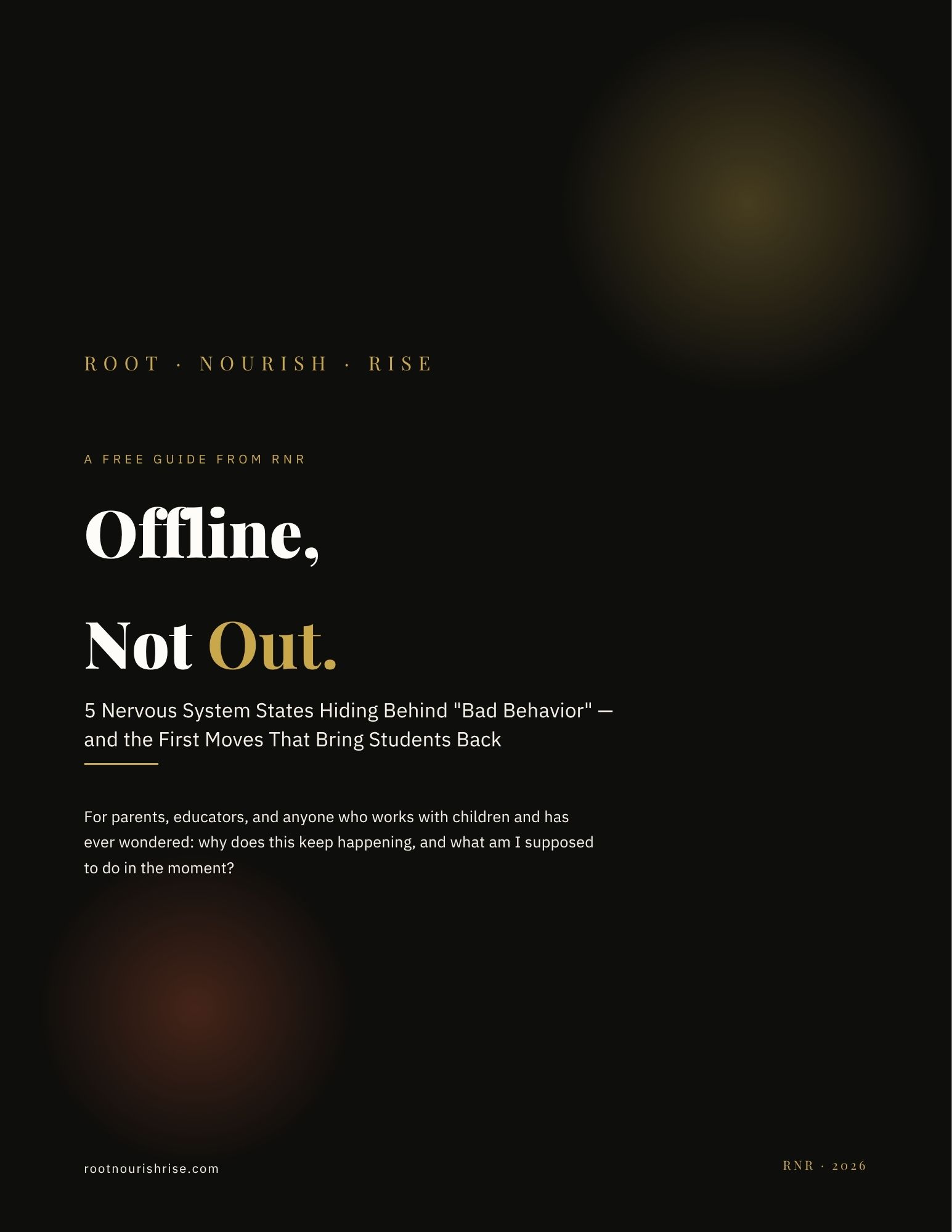
Offline, Not Out:
5 Nervous System States Hiding Behind "Bad Behavior"

A practical guide for parents and educators that translates what you're seeing in the classroom and at home into what's actually happening in the brain — and what to do in the moment.

  • The 5 dysregulation states and how each one looks in a child
  • Why "focus," "try harder," and "sit still" make it worse
  • The difference between avoidance and self-regulation
  • First moves that bring a student back into their learning window
  • What co-regulation actually requires from the adult in the room
Get the Free Guide + Join the Waitlist

Be first.
Founding members get everything at a different price.

Tell us a little about yourself so we can make sure what we build actually serves you.

No spam. Ever. Just the work that matters.

You're in.

Welcome to the RNR community. Check your inbox for your free guide and watch for founding member updates. We're building something real — and you're part of it from the beginning.